Five sources, five tools
Call records in spreadsheets, intelligence reports in another system, a network drawn by hand, pins on a separate map, watch lists somewhere else.
Intelligence mapping · from Solirius Reply
OspreyFlow joins records about people, places, objects and events into one network your analysts can explore, question and act on. It is open source, with no software licence fee, and runs inside your own cloud or data centre.
Follow OspreyFlow from three seats: the analyst who investigates, the developer who brings data in and writes the rules, and the administrator who runs it. The screens are illustrations and every name is invented.
Analyst · 1 of 4
Expand from one person, find the communities, and trace the path between two people.
Analyst · 2 of 4
A drawing board holds what an analyst knows that the data does not yet say: attributed, marked, graded and sourced.
Analyst · 3 of 4
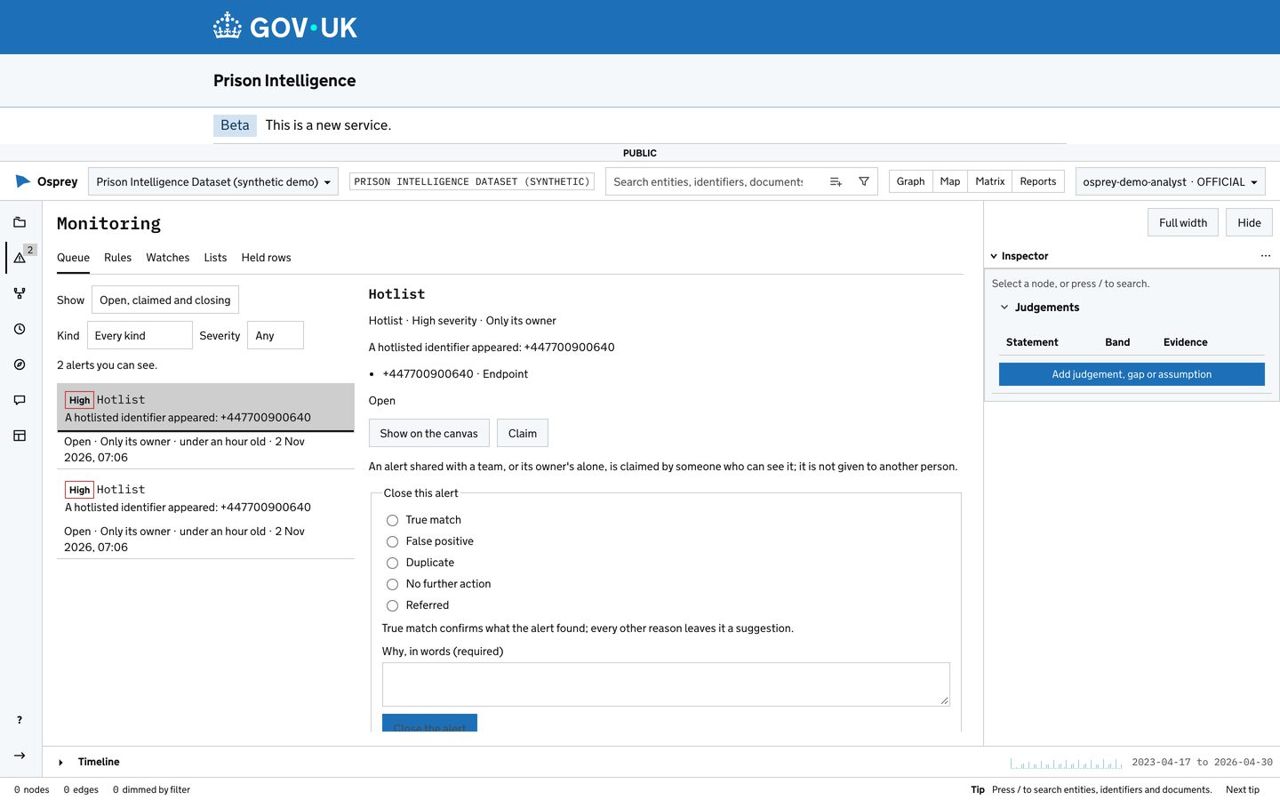
One queue for every alert you may see. A person decides each one, with a reason, and a second person approves closing a high-severity one that others may see.
Analyst · 4 of 4
Trends and report packs for analysts, and dashboards for the people who read the figures, drawn from the same data the analysts work with.
Developer · 1 of 3
A domain model for each dataset: its entity types and the links between them, kept as numbered versions, one live and one draft.
Developer · 2 of 3
A source, its mapping and its runs. Verify shows the result before anything loads, and a load can be taken back.
Developer · 3 of 3
Rules are built from your own types and links, previewed on the last 90 days, tested on the last 30, and only then made live.
Administrator · 1 of 4
The Glass, the Conduit and the Vault, separated by four typed ports, all inside your own cloud or data centre.
Administrator · 2 of 4
Roles, teams, markings and clearance. Access is enforced in the store, so a record someone may not see leaves no trace in a count or a path.
Administrator · 3 of 4
Every load is recorded with the pipeline version that made it, and can be reverted. The dataset's model is versioned: one live, one draft, and every earlier version can be restored.
Administrator · 4 of 4
Who did what and when: loads and promotions, people and roles, datasets, and every read that was refused.
Call records in spreadsheets, intelligence reports in another system, a network drawn by hand, pins on a separate map, watch lists somewhere else.
Links are missed between tools and teams. The chain back to the source breaks in every copy. Access is set up five times, five ways.
Analysts spend their weeks preparing data. Findings are hard to defend when they are challenged. Figures for leadership are typed in again by hand.
OspreyFlow loads each source through a pipeline, resolves the same person across them and shows the result as one network, read as a graph, a map, a timeline, tables and reports. A filter in one view applies in all of them.
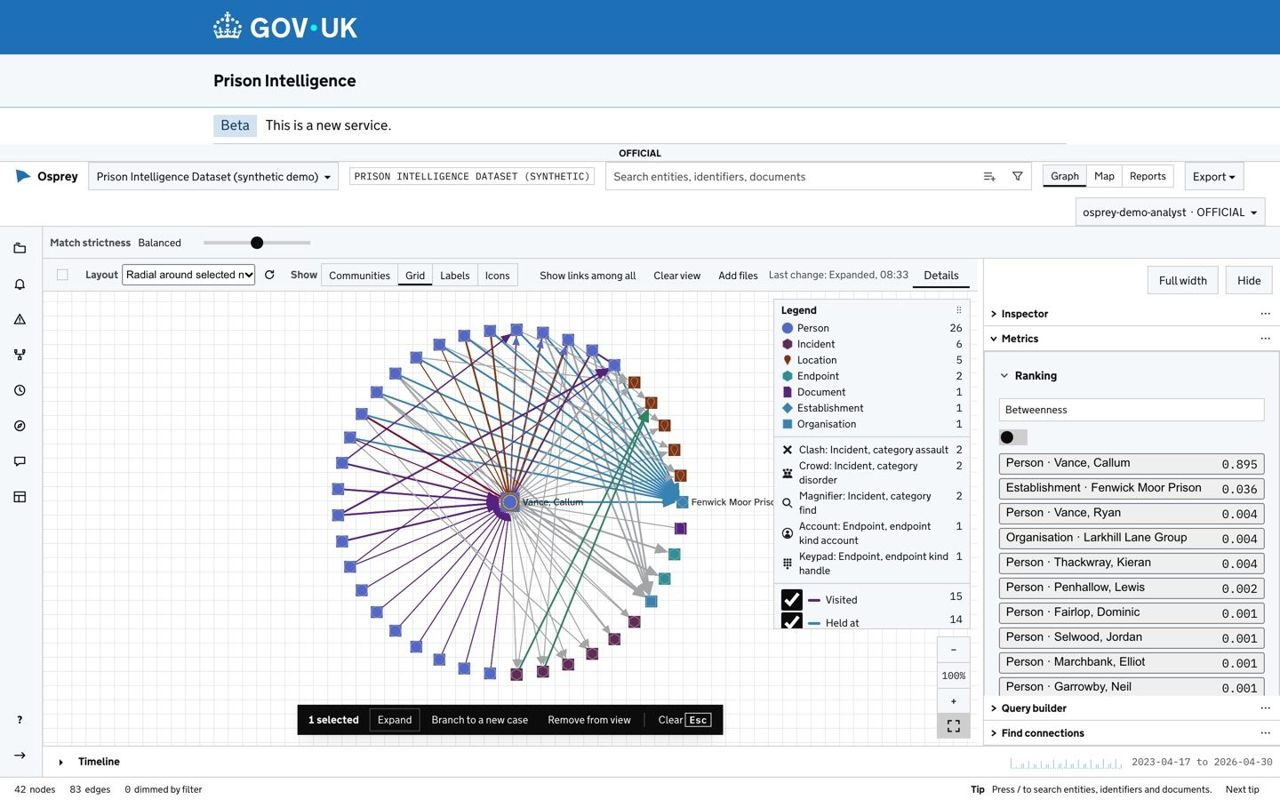
Every link shows where it came from. A model's suggestion stays inferred until a person confirms it. A match can be undone.
Apache-2.0 open source. You own the data, the deployment and the roadmap you ask of it. No per-seat licence.
Runs in your own cloud account or data centre. Nothing leaves unless an administrator enables it for a dataset.
Access is enforced in the store, so a record someone may not see leaves no trace in a count, a path or a chart.
For private and public sector organisations alike.
Call records, intelligence reports, people, places and events in one network, with every link traced to the record it came from.
Shared addresses, accounts, contact details and directors across payments and companies, with rules that raise an alert when a pattern returns.
Customers screened against sanctions lists and re-screened when a list changes; typology rules for structuring, rapid movement and circular flows.
Cell-shares, visits, calls, incidents and finds read together, on a map of the site and a clock of the week.
OspreyFlow includes a dedicated configuration for UK government: the GOV.UK Design System's look, government security markings with need-to-know access, and a full audit trail.
OspreyFlow is designed to meet the GDS Service Standard. Three independent checks are planned and not yet done: an independent accessibility audit, a penetration test and a data protection impact assessment (DPIA). Only a service assessment panel decides whether a service meets the Standard, and it looks at a service, not at a product alone.
A few weeks on your own or anonymised data, with a handful of analysts, ending in a short report of what was found.
A production deployment in your own tenancy: pipelines for your sources, your sign-in and your look.
Support, new sources and teams, and dashboards for leadership.

Since 2007, Solirius has helped organisations across the public and private sector simplify complex technology problems with people-centred solutions. Solirius is part of the Reply Group. OspreyFlow is its open source intelligence mapping platform for crime analysis, anti-money-laundering, fraud detection, and event monitoring and alerting, released under the Apache License 2.0.